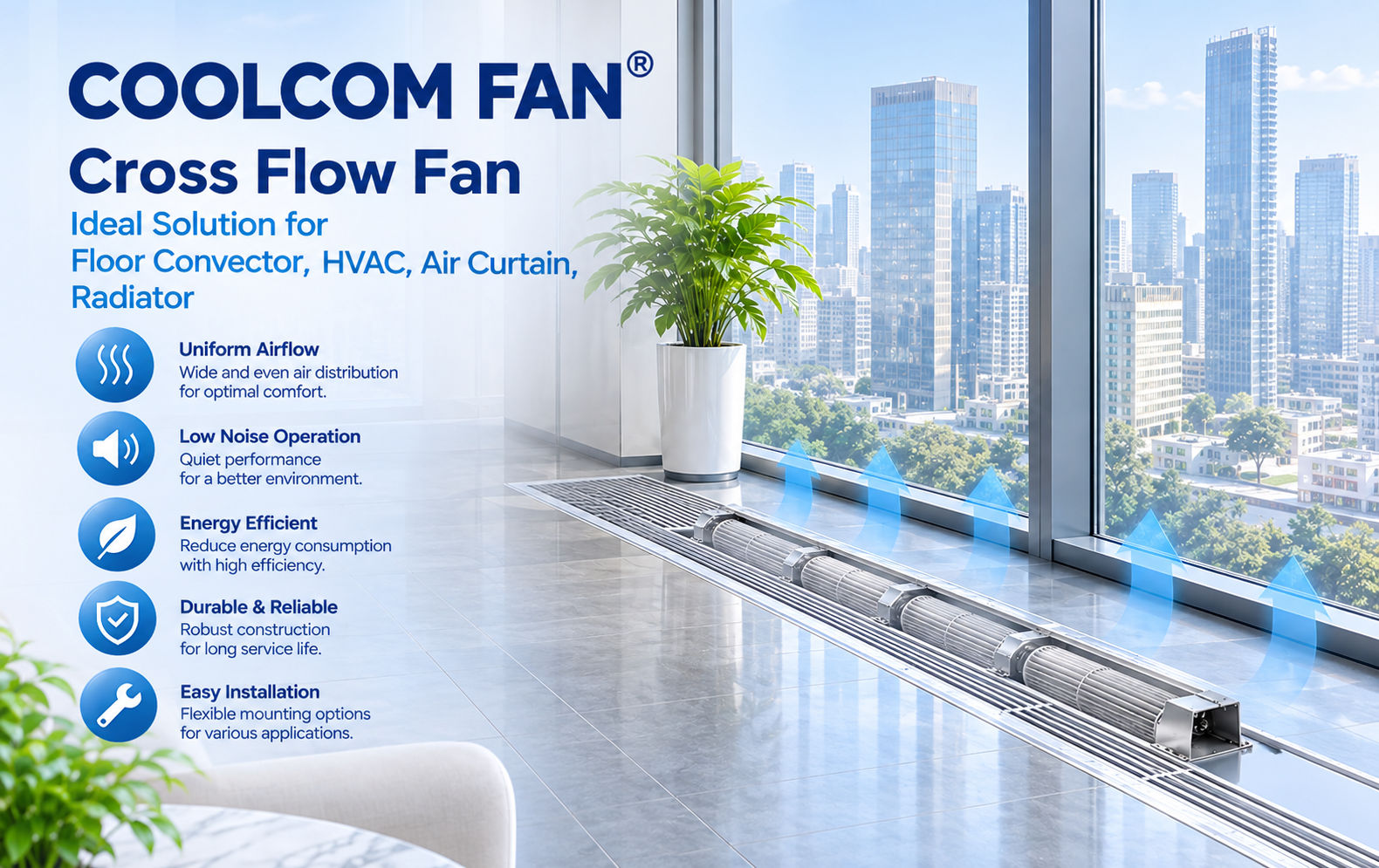
Application of Cross-Flow Fans in Floor Convectors and Trench Heaters
Floor convectors and trench heaters belong to the same type of HVAC terminal units: embedded heating/cooling terminals pre-buried in floor trenches and arranged along curtain walls. They are available in natural convection versions and forced convection versions equipped with cross-flow fans. As the core air supply component for forced models, cross-flow fans fit perfectly with their design requirements of narrow, long trenches and forming uniform air curtains along glass facades.
1. Why Cross-Flow Fans Instead of Axial or Centrifugal Fans
Core features of cross-flow fans: long cylindrical impeller, slim profile, uniform air discharge along the full length, low static pressure and low noise.
✅ Matching the profile of trench housings: Trenches are long and narrow, normally only 100–200 mm in height. The cross-flow impeller has a small diameter and its length can be extended to match the trench. The motor is mounted at the end without occupying vertical space, so it fits inside the trench easily.
✅ Continuous planar airflow: Consistent air output along the full trench length. Air streams rise along the glass to form a continuous hot air curtain, blocking cold downdraft from glass surfaces and preventing condensation — an effect difficult to achieve with discrete air supply from axial fans.
✅ Gentle air supply with low velocity: No draft sensation, suitable for residences, hotels and exhibition halls. EC versions support 0–10 V stepless speed regulation and can be interlocked with thermostats and water valves for variable capacity control.
✅ Noise performance: With proper dynamic balancing and vibration isolation, typical operating noise ranges from 30–40 dB(A), close to indoor background noise. The trench structure further attenuates vibration and noise.
⚠️ Inherent Limitations (critical for selection)
- Very low static pressure: Suitable only for low-resistance air paths. Airflow drops sharply when filters or fin coils are clogged with dust. Service access for cleaning must be reserved; fully sealed construction is not allowed.
- Lower aerodynamic efficiency than centrifugal fans, leading to relatively higher power consumption at full load. EC brushless motors are therefore preferred.
- Large length-to-diameter ratio for long impellers. Intermediate supports and qualified dynamic balancing are mandatory to avoid resonant noise.
2. Assembly Structure & Airflow Path (Cross-Flow Fan Type)
Sequence from bottom to top / air inlet to outlet:
- Housing (galvanized steel / stainless steel trench) + bottom vibration isolation pads
- Cross-flow fan assembly (impeller + scroll casing + EC motor)
- Heat exchanger core: copper tube aluminium fin coil (2-pipe heating / 4-pipe heating & cooling). Electric heating models replace the coil with electric heating modules.
- Air guide plate and inlet filter
- Top grille (roll-up grille / linear grille, load-bearing for pedestrian traffic)
Airflow route:
Indoor air enters through the lower part of the grille → drawn in by cross-flow fan → passes transversely through the fin coil for heat exchange → discharged obliquely upward via the air guide plate, climbing along the curtain wall to form an air curtain. In winter, it suppresses cold downdraft from glass; in summer, cooled air rises along glass then settles, achieving precise perimeter temperature control.
Comparison with natural convection units: For the same trench dimension, the heat output of forced cross-flow models can reach 4–5 times that of natural convection types. They are ideal for low-temperature water heat pump systems, large glass areas, high perimeter heat loads and limited trench length.
3. Fan Selection Guidelines for Engineering Implementation
- Impeller Dimension: Impeller diameter is determined by trench height; common sizes φ40, φ50, φ60 mm. Impeller length roughly equals the effective heat exchange section. Multiple cross-flow fans can be spliced for long trenches with synchronous control.
- Motor Options
- EC Brushless DC (mainstream premium): 0–10 V / PWM speed control, low power consumption, adjustable speed, thermostat interlock; preferred for villas, hotels and office buildings.
- AC Shaded-pole / Capacitor-run motor: Low cost, fixed speed; mostly used for low-end electric trench heaters.
- Operating Point: Cross-flow fans are low-pressure units, selected at static pressure of 10–30 Pa. Total resistance from grille, filter, fin coil and internal ductwork must be checked and kept below the fan rated static pressure.
- Temperature Resistance & Material: For hydronic models, discharge air temperature is generally below 50 ℃; ABS impellers are acceptable. For electric heating models with high air temperature, aluminium alloy impellers are recommended to avoid thermal creep and deformation.
- Noise Control: Rubber vibration isolators between fan and housing. Scroll profile and cutoff position are key for cross-flow noise reduction; the air duct profile shall not be modified arbitrarily. Hard connections that transmit vibration to stone flooring must be avoided.
4. Typical Application Scenarios
- High-end residences with large floor-to-ceiling windows and sunrooms (eliminating cold sensation near windows and anti-condensation)
- Office buildings, exhibition halls, hotel lobbies along glass curtain walls
- Low-temperature water heating heat pump systems (natural convection units deliver insufficient capacity at low supply water temperature)
- Some projects reserve fresh air ports for mixed fresh air supply via the cross-flow fan
5. Common Faults & Maintenance Notes
- Reduced airflow and rising noise: Filter or fin coil fouling increases flow resistance. Cross-flow performance is highly sensitive to clogging. Annual cleaning (1–2 times) is recommended.
- Abnormal noise and periodic hum: Failed impeller dynamic balance, bearing wear or resonance. Long impellers without intermediate support discs are prone to shaking.
- Uneven air distribution along length: Misaligned scroll casing or air guide plate shifts the vortex core, a typical assembly issue for cross-flow fans.
- Cooling mode: Heating & cooling versions with cross-flow fans must be fitted with drain pans and drain lines to prevent condensate accumulation inside the trench.
6. Comparison: Natural Convection vs Cross-Flow Forced Trench Heaters
| Item |
Natural Convection Type |
Cross-Flow Forced Type |
| Heat Output |
Low, limited capacity for same footprint |
High, approx. 4–5 times |
| Trench Height |
Usually deeper and longer |
Compact, shallower trench available |
| Noise Level |
Near-silent |
30–40 dB(A), quiet at low speed |
| System Compatibility |
High-temperature water, low load, ultra-quiet spaces |
Low-temperature heat pump water, heating & cooling, large glass facades |
| Power Consumption |
No fan power draw |
Continuous fan power consumption (low for EC) |
| Maintenance |
Fin coil cleaning only |
Filter, fan bearings and fin coil require servicing |