

Comparison of Square-Wave, Sinusoidal and FOC Control Technologies
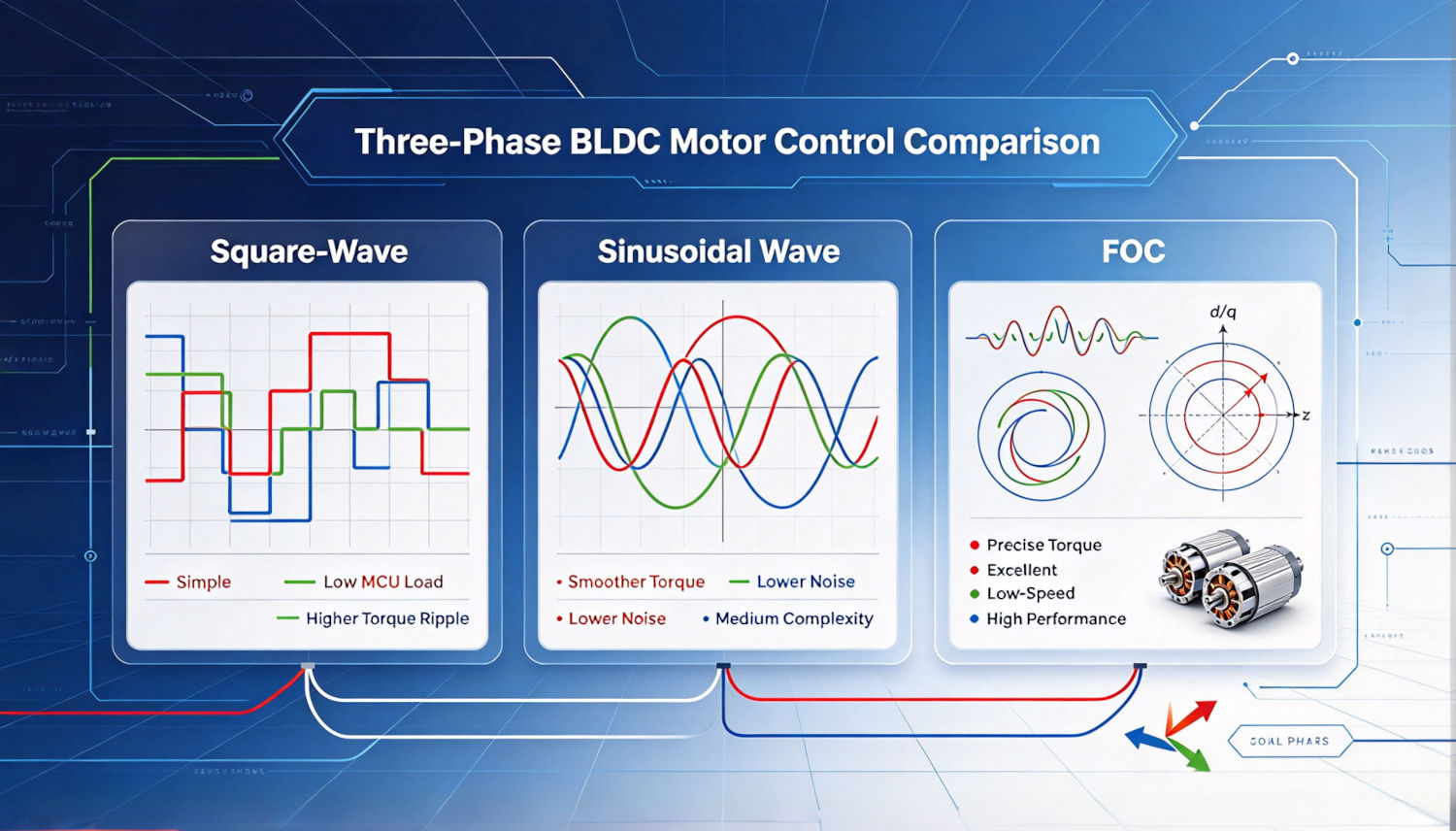
Three-phase brushless DC (BLDC) motors are widely used in cooling fans, blowers, air purifiers, industrial equipment and smart home appliances.
Motor control technology plays an important role in determining motor efficiency, operating noise, torque stability, speed regulation and overall performance.
There are three common control methods for three-phase BLDC motors: Six-Step Square-Wave Control, Sinusoidal Wave Control and Field-Oriented Control (FOC). Each technology has different advantages and limitations. Choosing the right control solution helps achieve the best balance between performance, efficiency and cost.
Square-wave control, also known as six-step commutation or 120-degree conduction control, is one of the most common methods for driving three-phase BLDC motors.
The controller switches the three motor phases in six sequential electrical states. Typically, two phases conduct current while the third phase remains floating.
Cooling fans, ventilation systems, pumps and cost-sensitive household appliances.
Sinusoidal wave control drives the three motor phases with continuously varying sinusoidal currents, with each phase shifted by 120 electrical degrees.
Compared with six-step control, sinusoidal control produces smoother electromagnetic torque and reduces current harmonics and commutation-related vibration and noise.
Low-noise cooling fans, air purifiers, home appliances, ventilation equipment and other applications requiring smooth operation.
Field-Oriented Control (FOC), also known as vector control, is an advanced motor control technology designed to precisely regulate the magnetic field and torque of a three-phase motor.
FOC uses mathematical transformations, including Clarke and Park transformations, to convert three-phase currents into d-axis and q-axis components.
By independently regulating these components through current control loops, the controller can achieve precise torque and speed control.
High-performance cooling fans, high-speed blowers, precision pumps, electric tools, HVAC systems and premium household appliances.
| Performance | Square Wave | Sinusoidal | FOC |
|---|---|---|---|
| Control complexity | Low | Medium | High |
| Torque ripple | High | Low | Very low |
| Operating noise | Higher | Lower | Very low |
| Low-speed performance | Basic | Good | Excellent |
| Speed regulation | Basic | Good | Excellent |
| Torque control | Basic | Moderate | Precise |
| MCU requirements | Low | Medium | High |
| Development cost | Low | Medium | High |
Note: Actual performance depends on motor design, rotor position detection, current sensing, switching frequency and control algorithm optimization.
Different applications have different motor performance requirements. The most suitable control method depends on the balance between cost, efficiency, noise and control precision.
Recommended for standard cooling fans and cost-sensitive applications where simple control and reliable operation are the priorities.
Recommended for low-noise household appliances and ventilation systems that require smoother operation and reduced vibration.
Recommended for high-performance blowers, precision speed regulation, demanding low-speed operation and applications requiring accurate torque control.
At Coolcom, we understand that different cooling applications require different motor control technologies.
We provide motor and cooling solutions designed around application-specific requirements, including:
Our goal is to help customers achieve the right combination of airflow, energy efficiency, noise performance and product reliability.
Looking for a suitable three-phase BLDC motor or motor control solution for your cooling application?
Contact our engineering team to discuss your requirements. We can evaluate motor specifications, control methods, operating conditions and application requirements to help identify a suitable solution.


